A faithful remnant reserved through the ages
by the Holy Spirit and the Word of God.

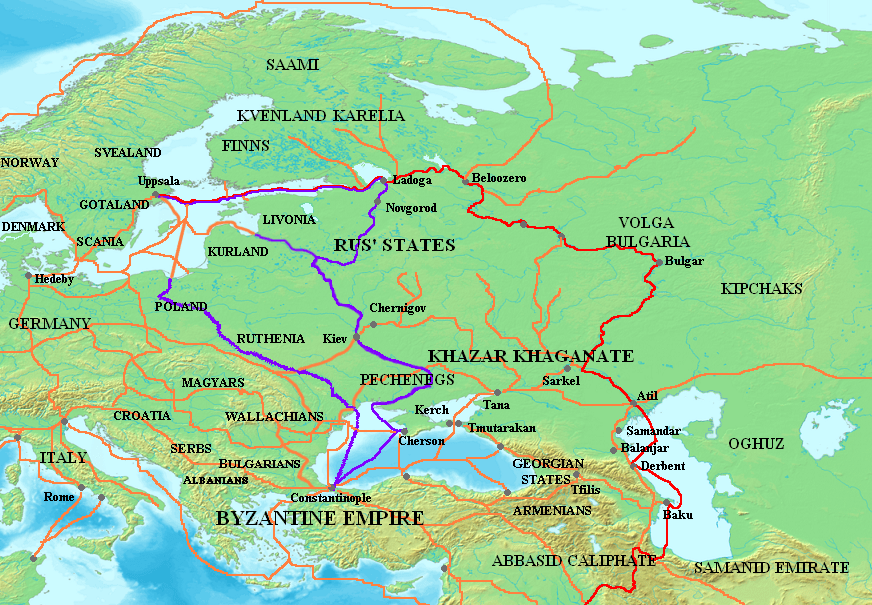
Kiev – 989 A.D.
Pride poured out over each stone as Andrew smoothed the mortar with his trowel. Quietly he worked, stone by stone, building a section of wall, while thinking about events of recent days, amazed at how quickly his life had changed, changed for the better.
He and six other masons came from Constantinople, commissioned by Prince Vladimir, to build a church.
Upon arrival to the monastery, where they were housed as guest workers, the monks told the story of how in one day most everyone in Kiev, by unction of Prince Vladimir, had been baptized as Christians in the River Dnieper.1
Now after coming to the monastery in Kiev, Andrew let go of his bitterness, and gladly embraced Christianity. At baptism his real name, Tobias, had been changed to Andrew–named after Apostle Andrew who, long ago, preached the gospel to the people along the River Dnieper.
Most amazing to Andrew was God graciously moving his master to award him freedom from slavery in order to serve as a priest at the new church he was building. For now, he was a monk while he learned to read and recite the liturgies.
Learning to read! He never dreamed it would be his privilege. And to be a priest! Recite scriptures and prayers. He could hardly wait till he finished his studies to be ordained.
Originally, Andrew Tobias and the other masons had come from Bulgaria–prisoners of war, captured and brought back to Constantinople. Instead of being kept in a crowded prison they were forced to become slaves. Captured when young boys while working in the fields, and even though most were age twelve or older and considered young men, it had been heartbreaking to be torn away from their families.
At least all seven boys had been kept together. Along with Andrew were Marc, the eldest and the lead builder; Jairus, the quiet methodical type and his blood brother Evan, who was quite opposite–boisterous and compulsive; Lucas, who was known for his sarcastic wit, especially when it came to picking on his brother, Alex, who did not seem to mind that his own antics usually made others laugh at him; and Theo, the youngest, who was quiet and shy.
They were family, relying on each other, communicating amongst themselves in their own Slavic language, but while working in Constantinople as masons they learned to speak Greek as well.
Andrew learned from one of the monks that Greek missionaries had gone to Moravia more than 100 years ago and had translated liturgies into the Slavic language.2 He felt as though God had prepared everything in advance so that he could learn to read and recite the scriptures in Slavic, his own heart language.
Andrew Tobias certainly had many opportunities to be baptized and attend a church service while in Constantinople, but pride and anger had kept him away from church and God.
He questioned God’s providence. If God cared about him, why did he allow him and the others to be captured and made to be slaves?
He questioned God’s love. Why did God make him suffer when he was doing good…working hard…taking him away from his family?
He questioned God’s justice. His master claimed to be a Christian and gave his slaves Sunday off to go to church, but they had to go to a house church–a church for slaves, not to the public churches where the aristocrats go–not even to the churches that they had built stone by stone.
Yet, despite all the sorrow he felt, when commissioned to go build a church in Kiev, slowly the bitterness began melting away. And he was honored to live among the monks at the monastery.3
He asked God to forgive him and trusted Christ’s death to pay the penalty for his sin and Christ’s resurrection to give him a new life forever.
Soon after he received Salvation, unexpectedly, his master released him from slavery so that he could become a priest. He was overwhelmed with joy at God’s answer to his prayers.
Most of his brothers also struggled with becoming Christians. Sorrow, then pride and anger kept them locked in bitterness and unforgiveness. Except Theo, he embraced Christianity while in Constantinople, yet he too experienced prejudice amongst some Christians there.
Soon after Andrew had been released from slavery, the other masons, Marc, Jairus, Evan, Lucas and Alex professed faith in Christ too and were baptized. However, Andrew had doubts about their faith. Was their baptism pretense in order to be released from slavery as he had been? Even so, Andrew loved them all and hoped for the best. And although his brothers were released from slavery, unlike Andrew, they did not commit to becoming priests.
And each one of his brothers had their own dreams for the future. They talked about traveling back to where they had been born to find their families. Perhaps become merchants traveling along the River Dnieper, then cross over into Bulgaria. They discussed “what ifs”–What if their families have left Bulgaria? Or died? Or could not be found? Andrew thought about going along with them and then after return to Kiev he could pursue becoming a priest.
Andrew fit the last stone in place, then smoothed mortar to secure it, and stood back, admiring the section he completed.
According to schedule, the masons finished the portion of wall by the end of the day and walked back to the monastery to rest and have their evening meal.
Brother Dmitri served them fresh baked bread, cheese, roasted grain, and goat’s milk before sitting down with them. He prayed with them, then read from the scriptures while they ate.
Dmitri, the eldest priest at the monastery, had befriended Andrew and his brothers, taking them under his wing, to teach them, watch over them, and keep them out of trouble.
After he finished reading, he opened up conversation by asking about their work for the week.
“How’s the wall coming along…everyone looking forward to worship tomorrow, the Lord’s Day?” It was a subtle hint to remind everyone to prepare for chapel worship in the morning.
Marc, the lead mason, spoke to the progress on the wall. “We’ve finished the lower northern wall…planning to start on the eastern wall, perhaps Monday, if the stones are brought by then. If not…well…we will see…”
Alex perked up remembering a visit by one of the stonecutters earlier in the morning. “I am very sorry…I’ve forgotten to report a message from one of the stonecutters…he came while I was on my way back to the monastery…said to tell you Marc…stones coming on Monday…but may not be enough…if not, we can help with the carving.”
Marc pursed a smile, “And I think I know why you forgot to tell me.”
Embarrassed and red-faced, Alex grinned while the others grumbled about the possibility of having to cut stones.
Then Lucas added. “Perhaps, Alex thought if he forgets to relay the message, then, magically, somehow there will be enough stones–then we’ll not have to help with the carving on Monday.”
Jairus and Theo laughed as they both agreed. “We hope it works!”
Andrew chuckled along with everyone. “I’m forgetting all about stones and building for a day–looking forward to singing the Psalter with the priests tomorrow.”
Brother Dmitri encouraged Andrew. “Yes! Your first time singing with us–sure to be a harmonious addition!”
“I hope so–and soon–reciting liturgies too, I hope.”
Dmitri’s face became more serious as he leaned forward to speak privately with Andrew. “I’m reminded of something I need to speak about with you. Yesterday, the Bishop came to visit me. He was checking on progress of building the church here.
“Prince Vladimir has ordered another church to be built in a village nearby. And perhaps even more churches after that. He strongly recommended that the current crew be retained to go on to the next project.”
He said, ‘Experience will expedite the progress!’”
Andrew gazed at the candle on the table while thinking–thinking about his promise to his former master to become a priest–thinking about how he longed to settle down, longing to have a home at the monastery.

Also, he enjoyed the honor and respect he received now as a monk and even more so as a priest.
While waiting for Andrew to collect his thoughts and respond, Dmitri added. “I know this may be disappointing to you…and you can think about it…pray about it….”
Andrew looked up at Dmitri with a peaceful smile in his eyes. “Then it’s not a command by the Bishop? It’s a request?”
“Ohm…well…yes, the Bishop did not demand…it is a request.”
Both were silent with their own thoughts for a few more moments, then Dmitri added. “Andrew, I want you to think about the opportunity for building more churches. God could be moving you to serve him this way, instead of being a priest–more churches in other villages means more people becoming Christians.”
Andrew continued staring at the candle while pondering. More churches…more Christians.
Dmitri smiled widely as he patted Andrew on the shoulder then softly, almost in a whisper, he said, “Ask God what he would have you do–trust him.”
Dmitri stood to say goodnight, enfolding the scripture book in his arms. “Sleep well everyone…see you all in the morning.”
For the remainder of the evening, Andrew was determined not to think about giving up being a priest or building more churches. He wanted to sleep so he could rise early and prepare for worship. However, tossing and turning, he could not sleep, and when finally, after falling asleep, he was awakened by snoring.
He and his brothers shared sleeping quarters, each with their own bedding in a large room. It had been a meeting room and library for the priests, which they converted to house the masons while they built the church. A shelf of books still remained beside the window with a bench below the window for sitting while reading with the aid of daylight. To move further away from the snorer, Andrew got up to sit on the bench, tucked his pillow behind his back and pulled his feet up to lay back while looking out at the starlit sky.
Dmitri’s words came to mind, Ask God what he would have you do…
Andrew hesitated, wrestling and resisting like a rebel. He tried to make himself numb to thoughts. Tried to sleep. Curling up in his blanket, he dozed and then startled awake after almost falling off the bench. He stumbled back to his soft, thickly padded mat and went back to sleep just before daylight.
As he stood with the choir later that morning, he was sure that lack of sleep would make his singing go flat. But he humbled himself and asked God to help him sing. He was amazed to hear his own voice energized, resonating in praise to God, yet God speaking to his own heart through the psalm he was singing.
Psalm 67
“May God be gracious to us and bless us
And make his face shine on us—
So that your ways may be known on earth,
Your salvation among all nations.
May the peoples praise you, God;
May all the peoples praise you.
May the nations be glad and sing for joy,
For you rule the peoples with equity
And guide the nations of the earth,
May all the peoples praise you.
The land yields its harvest;
God, our God, blesses us.
May God bless us still,
So that all the ends of the earth will trust him.”
Meaningful phrases of the psalm echoed in his heart. So that your ways may be known on earth…Salvation among all nations…
Tears moistened the corners of his eyes as he knelt down with the others to pray. Silently he prayed his own prayer to God.
Heavenly Father, I surrender to your will…so that your ways may be known…so that others will trust you…so that people in other villages may praise you…I will build more churches…if you send me, I will go…

This story is a fictionalization. Although, actual historical events, people and places are used, details of the time period have been portrayed as accurately as possible for authenticity. All characters are fictional unless otherwise noted. If an actual historical person is mentioned an endnote with citation will be included.
1. Wikipedia. Vladimir the Great. <en.wikipedia.org/wiki/Vladimir_the_Great> Grand Prince of Kiev 980-1015 AD. Venerated as a Saint for the Christianization of *Russia. He built The Church of Our Lady from 989 to 996.
Graves, Dan. Christian History Institute. Article # 25, In Context, We Did Not Know Where We Were.<christianhistoryinstitute.org/incontext> In a magnificent show of God’s sovereignty a pagan ruler, Vladimir, who worshiped idols embraced Christianity and established Christian religion for himself and his nation. During his reign from 980 -1015 A.D. he built many churches, paving the way for Russia to become a leading Orthodox Christian nation.
2. Schaff, Philip. History of the Christian Church. Peabody, MA: Hendrickson, 2006. Vol.4, pp. 128-142. Cyrillus and Methodius, the Apostles of the Slavs. Christianization of Moravia, Bohemia and Poland. The Conversion of the Bulgarians. The Christianization of Russia. In 863 AD, Greek missionaries, Cyrillus and Methodius, by invitation from the King, went to Moravia to establish a church. Cyrillus understanding Slavic language, developed an alphabet for the local Slavic language (currently known as Cyrillic Alphabet). Then he translated liturgies to use in worship. Since the people were able to worship in their own language, the Church grew quickly. Later when war caused upheavals of church and state, the priests fled taking their Slavic translations with them to Bulgaria and Bohemia and then later into *Russia. Russian Christians having scriptures in their own language, facilitated spiritual growth and expression of Christianity in their culture.
*Mark, Joshua J. World History Encyclopedia. Kievan Rus. <worldhistory.org/Kievan_Rus/> Kievan Rus established in 862 AD by King Rurik. A federation of modern-day areas of Belarus, Russia and Ukraine. Conquered by Mongols in 1242 A.D.
3. Wikipedia. Mezhyhirya Monastery. <en.wikipedia.org/wiki/Mezhyhirya_Monastery> First monastery established in 988 AD in Kievan Rus.
Scripture quotations taken from The Holy Bible, New International Version©, NIV© Copyright ©1973, 1978, 1984, 2011 by Biblica, Inc. © Used by permission. All rights reserved worldwide.
 Treasures of the Lord